Château Talbot

Château Cantenac Brown
Margaux Cabernet Sauvignon Blend 1986

Flight 4 , wine 2. This was quite a difficult wine to read at first , again quite closed , mineral and tobacco edged . Dark fruits. On the palate rounder than expected , good richness and balance , dark cherry , blackberry fruit . Good rounded tannin and ok length . Quite obviously Bordeaux in the context of this tasting , though I had this as the Lynch Bages 1982 when it was actually the Brane Cantenac 1986 …..I give up ! 90
This was an interesting , though challenging tasting , all served blind in flights of 2 wines , 3 flights of 1 Napa and 1 Bordeaux and 1 of 2 Bordeaux; served in a random sequence . The fact that at least a couple of wines were not pristine didn’t help , though if you will taste 8 , 40 year old wines that is probably par for the course . I found it relatively easy to spot whether what was in the glass was Napa or Bordeaux but didn’t actually get a single wine completely correct ! Probably overall the winner of the tasting was Napa (won the 3 rounds 2-1) as they had more suave polished , rounded personalities. Many put the wines the wrong way round , imagining that Napa was Bordeaux etc. The 1982s in general showed poorly too much funk and brett on the Lynch and Talbot but the Duhart showed surprisingly well . The 86s both showed pretty well and equalled the Dominus (even though I didn’t think we had a pristine bottle) . The Montelena was enjoyable , though was the first to oxidise whilst the Inglenook was the biggest positive surprise , still drinking surprisingly well at 47 . — 2 years ago
Connétable de Talbot
St. Julien Red Bordeaux Blend 1995
Oldschool Classic at it’s best!
Surprisingly fresh in the nose with black currant leaf, a pleasant greenness, pencil shavings and a plethora of tertiary aromas.
On the palate this is rather light bodied with still quite youthful grippy tannins, juicy acidity and great length.
This is poised, has presence and really good length.
Classic!! — 4 years ago
La Rochelle Winery
Sleepy Hollow Vineyard - Block A Pinot Noir 2003
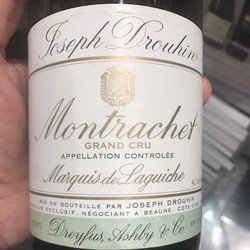

2003 vintage, a bit muddy right out of the bottle but distinct cherry and dark fruit on the nose and palate. A leading vineyard in Monterey at the cool north end of the Santa Lucia Highlands. <300 cases - 10 barrels in French and US oak. Robb Talbot grower, Tom Stutz winemaker. — 7 years ago
Château Gruaud Larose
Larose de Gruaud St. Julien Red Bordeaux Blend 1986
A mini ‘86 showdown with this against a Talbot. I found both to be extremely similar with a slight edge to the Talbot. This was lighter on the palate with red fruit dominated primary notes and a mix of cherry pipe tobacco, leather, cedar and herbal spice. Drinking nice. — 8 years ago
La Croix de Beaucaillou
Saint-Julien Red Bordeaux Blend 1999

Nice wine for this vintage. Softer tannins than those of Talbot 2010. Velvet on the palate. Nice black fruits on the nose and on the palate. Quite long. Quality time too! — 9 years ago
Château Talbot
Connetable de Talbot Saint-Julien Red Bordeaux Blend 2019

Bordeaux City Center.. Brasserie Bordelaise.Very good well balanced wine . Pair w Grill meat — a month ago
Château Talbot
Medoc Red Bordeaux Blend 1959
Magnum. 1959 still some acid and drinkable. — a year ago
Château Duhart Milon
Pauillac Cabernet Sauvignon - Merlot Blend 1982
Flight 2 , wine 2 . This was again quite deep with a slightly marked terracotta rim . Quite closed and difficult to read at first , touch of coffee and herbal hints , some sous bois . This needed time to unfurl a bit and showed well over all . On the palate this had dark fruits and a mineral , grafite , tobacco edge , quite elegant and still showing well . Slightly dry compact tannins , but good balance and length . I had this down as the Talbot 82 … but alas I was wrong again .. at least got the vintage . — 2 years ago
Château Talbot
Caillou Blanc Bordeaux Sauvignon Sémillon 2019

too much new oak flavour. Needed bigger glass! but, texture is incredibly creamy, silkx, adding comfortable complexity.
luck back bone acidity. — 4 years ago
Château Sénéjac
Haut-Médoc Red Bordeaux Blend 2018
2018 vintage. Estate owned by the Bignon Cordier family (Talbot). Cabernet Sauvignon (59%), Merlot (29%), Cabernet Franc (7%) and Petit Verdot. First vintage under the management of Jean-Michel Laporte and a very solid effort. Cassis and fine cedar wood. Very approachable fresh, fruitdriven Haut-Medoc with impeccable balance and good length. Terrific value at 15 euros.Highly recommended. Abv. 14%. — 5 years ago
Talbott
Diamond T Vineyard Pinot Noir 2014

What’s not to like about this Talbot Pinot? — 8 years ago
Château Branaire (Duluc-Ducru)
St. Julien Red Bordeaux Blend 2006
On the nose, bright, ripe, ruby; blackberries, dark cherries, black raspberries, blue fruit mix, strawberries, creamy raspberries, plums, cranberries, black tea, loamy soils, dry clay, dry stones, limestone minerals, saddlewood, crush dry rocks, dark moist soils, dark chocolate, vanilla, field of violets, lavender and fresh red florals.
The palate is medium-full yet a little lean. The fruits are elegant, ruby, ripe; blackberries, dark cherries, black raspberries, blue fruit mix, strawberries, creamy raspberries, plums, cranberries, black tea, loamy soils, dry clay, dry stones, limestone minerals, used leather, cedar, crush dry rocks, dark moist soils, dark chocolate, vanilla, field of violets, lavender and fresh red florals. The acidity is very good. The length, balance and length are nice. The structure a little lean. It a well polished rich fruit finish, but is a little short.
Photos of; the Chateau, Owner Patrick Maroteaux (may he RIP), Estate grapes and their barrel room.
Producer notes & history...Branaire Ducru has a long history has a long history that dates back to 1680. In those days, Branaire Ducru was a part of a larger Beychevelle. When the owner of Beychevelle passed away, he left behind a huge Bordeaux vineyard that was seriously in debt. To pay off the debt, the vineyard was broken up and sold. Several new estates were created in Saint Julien, which include Chateau Branaire Ducru. Jean-Baptiste Braneyre created the estate in 1680. As was was tradition in Bordeaux, the owner gave the estate his name, which is where the first part of the properties name came was given. Braneyre was later altered to Branaire. Braneyre bought the land we know as Branaire Ducru because of the terroir. He understood that Cabernet Sauvignon grew best on the deep gravel soils found in the Medoc. With that, we have the birth of Branaire Ducru. Or, at least the Branaire part. The middle name was gained through marriage. Marie Braneyre married Pierre de Luc which as you can guess, gave us the Branaire Duluc (the name of their 2nd wine). Almost 100 years later, the first winery at the property was constructed in 1824. It took almost 200 years for the Ducru portion of the wines name to make its way to the label. In 1875, with no direct descendants, Gustave Ducru, a more distant relative took over the property and added his name to the label making it, Chateau Branaire Ducru.
Patrick Maroteaux bought Branaire Ducru in 1988 from the Tapie family who had owned It since 1919. Prior to his ownership of Branaire Ducru, Patrick Maroteaux had no prior experience in the wine business. His background was in banking and then a president of the massive sugar company, Eurosucre. Patrick Maroteaux also served as the President of the UGCB, Union of Grand Crus Bordeaux, and as the President of the Saint Julien appellation.
Since his purchase, Patrick Maroteaux has focused much of his efforts on performing extensive work in the vineyards and in the cellars. He also began reducing the yields. Additionally, he increased the size of their vineyards by 10 hectares. Patrick was also modernized their winemaking techniques.
In fact, Patrick Maroteaux was one of the first producers in the Left Bank to being filling his tanks entirely by gravity. He did this beginning with the 91 vintage. This was done with the help of Philippe Dhalluin.
Philippe Dhalluin left Branaire Ducru in 2004 and took the same position as the director for wine making at Chateau Mouton Rothschild. Philippe Dhalluin was replaced by Jean Dominique Videau.
Chateau Branaire Ducru is a family business. The son of Patrick Maroteaux, François Xavier Maroteaux has carried the family business and joined the estate. Sadly, on November 19, 2017, Patrick Maroteaux passed away at the age of 67. His son, François Xavier Maroteaux took over the full time responsibilities of managing the property.
All the new technical improvements at Branaire Ducru quickly paid off for Patrick Maroteaux. Beginning with the 2000 vintage, Branaire Ducru became one of the top Saint Julien wines. It’s also one of the better values for high quality Bordeaux.
The 60 hectare vineyard of Branaire Ducru is planted to 65% Cabernet-Sauvignon, 28% Merlot, 4% Cabernet Franc and 3% Petit Verdot. The vineyard is very close to the size it was during the time of the 1855 Classification.
The terroir is deep gravel with clay soils. The best terroir is located near the chateau, closest to the Gironde river. They also have blocks further inland, with a small section of vines placed close to Chateau Lagrange and Chateau Talbot. The vineyard can be divided into 15 different blocks with 70 different parcels of vines. On average, the vines are close to 35 years of age. However, the estate has older vines as well. The oldest vines date back close to 90 years of age. The vineyard is planted to a vine density that ranges from 6,700 to 10,000 vines per hectare. The higher levels of vine density are for the newer plantings. The goal of the property is to continue increasing the vine density in all of their better terroirs.
Branaire Ducru, fermentation takes place in 28 temperature controlled, stainless steel tanks. The 28 vats vary in size. The vats range in size from as small as 30 hectoliters and up to 210 hectoliters. Each vat is sized for the needs of each specific vineyard parcel. Each vat is filled using the gravity based system.
Branaire Ducru is aged in 60 to 65% new, French oak barrels for between 16-20 months. The amount of new oak varies depending on the quality, character and style of each vintage. On average, the annual production is about 25,000 cases depending on the vintage. — 9 years ago


Château Talbot
Connetable Cordier Saint-Julien Red Bordeaux Blend 2020
Second label of Talbot, Cabernet Sauvignon dominant, deep Ruby color with aromas of red and black fruits with toasty spice. On the palate flavors of black raspberry, currants and black cherry with licorice, toasty oak and tobacco. Fine tannins, long finish ending with fruit, oak and earthy tobacco spice. Drinking well now! — 7 months ago
Château Lalande-Borie
Saint-Julien Red Bordeaux Blend 1990

Well stored bottle, No problems whatsoever Dark web info, Chateau Lalande Borie is a relatively new estate in the Medoc. The vineyard was initially created when the Borie family purchased 18 hectares of vines from Chateau Lagrange in 1970. To that, they added 12 more hectares of vines from various other growers, some of which needed planting.
Things changed with the 2018 vintage when the estate was renamed Le Petit Ducru.
Chateau Lalande Borie Vineyards, Terroir, Grapes, Winemaking
The 25-hectare, Left Bank vineyard is planted to 50% Cabernet Sauvignon, 40% Merlot, and 10% Cabernet Franc. The vineyard has a terroir of gravel and clay soils. The clay in the soil is part of the reason that today, you find more Merlot in the vineyard. Previously the Cabernet Sauvignon occupied 65% of the vineyard makeup.
The vineyard is well placed in the western part of the St. Julien appellation. It is situated inland, not too far from Chateau Lagrange, Chateau Talbot, and Chateau Gruaud Larose. The vineyard is planted to a vine density of 8,500 vines per hectare.
Read more at:https://www.thewinecellarinsider.com/bordeaux-wine-producer-profiles/bordeaux/st-julien/chateau-lalande-borie-st-julien-bordeaux-wine/ — 3 years ago
Château Poesia
St. Émilion Red Bordeaux Blend 2018

Bang on great right out of the bottle. This probably won't reach the potential of the Talbot in the long term, but it's right there ... Now. Also deep and opaque in appearance. Less fruit on the nose. Pepper, briar patch, and a subtle black licorice. This wine seems to already have settled into it's complete incarnation. Of course with it's medium acidity and solid alcohol level, maybe it gets better with age, but pop and pour it now just in case.
93 points — 5 years ago
Château Pichon Longueville Comtesse de Lalande
Pauillac Red Bordeaux Blend 2005
Last week was a combo of 4th Friday and Open That Bottle Night on back to back nights. Needless to say, the lineup between both days was full of heavy hitters, so I’m only posting standout bottles.
Fun to try next to a 2000 Talbot. This was decidedly lighter on the mid palate, but much more tannic at the finish. More to the red and black fruit spectrum showing black cherries, raspberries, underripe blackberries alongside lots of herbs, graphite, rose petals and cedar. The palate seems to beg for more time in bottle as it certainly gained power the longer it was open. I’d hold. — 7 years ago
Château Talbot
Cordier Saint-Julien Red Bordeaux Blend 1989

In vino dec 2017
Brought by Patrice big surprise — 9 years ago
KA
The Eighty Six NYC — a month ago